
A club management ecosystem for racquet sports is one digital platform that runs your entire club: court reservations, member accounts, recurring dues, tournament schedules, and member communications. Most tennis, padel, and pickleball facilities still try to manage daily operations by duct-taping separate tools together. The desk uses an off-the-shelf calendar widget, member dues run through a card reader on the counter, and social clinics are coordinated across messy group chats.
Replacing those disconnected pieces with a single operational engine and shared database changes the numbers quickly. Across standard commercial club deployments, unifying operations cuts administrative time by up to 30 percent while lifting overall facility utilization by 8 to 10 percent. Instead of staff re-entering booking data across standalone spreadsheets, every court booking, membership tier, and invoice updates the same record in real time.
What is a Club Management Ecosystem
A complete club management ecosystem goes far beyond processing hourly court bookings on a digital grid. It gives facility managers deep operational insight into which courts generate profit, tracks membership health, automates recurring accounting tasks, and coordinates multi-division tournaments without administrative gridlock. For players, it acts as a central hub where they can view club schedules, track their billing history, enter events, and connect with other members of comparable skill for competitive or social games.
Most commercial facilities rely on fragmented tools that fail to communicate. A standard club setup often involves an off-the-shelf calendar app for reservations, a standalone payment terminal, a separate email marketing account, and dozens of informal messaging groups. When those tools operate in silos, front-desk staff waste hours manually reconciling records across systems that were never designed to work together.
A functional racquet sports ecosystem replaces that patchwork by consolidating six primary functions:
- Membership records: Centralized member profiles, automated subscription renewals, tier management, and self-service portals where members update their own payment methods.
- Sport-specific court scheduling: Native logic built for tennis, padel, and pickleball that handles variable duration slots, peak-hour pricing rules, lighting automation, and split payments between doubles partners.
- Financial processing: Direct payment processing for membership dues, guest fees, coaching sessions, and court hires, linking transactions directly to member accounts without manual banking imports.
- Tournament and event operations: Integrated registration brackets, round-robin scheduling, automated waitlists, and instant notifications that fill empty slots when players withdraw.
- Operational analytics: Real-time metrics tracking court occupancy percentages, revenue generated per court hour, and membership churn patterns based on live club data.
- Role-based security: Tiered administrative permissions that grant front-desk staff access to daily court sheets while protecting financial reports and private member data.

Consolidating these functions into one connected system eliminates manual data entry.
The Real Cost of Fragmented Software Tools
Operating a facility through basic online calendars, paper notebooks, and disjointed messaging groups creates invisible overhead that drains operational budgets every month. When front-desk staff must confirm a court reservation on one screen, verify membership status on a second, and manually log credit card receipts into separate accounting software, simple bookings turn into multi-step administrative chores.
Those wasted administrative hours compound rapidly over a typical operating week. When a small local facility in Ireland consolidated its bookings into a unified platform, administrative work dropped by over 30 hours weekly, leaving desk staff free to focus on member retention and club programming rather than manually reconciling schedules.
The financial upside of eliminating disconnected tools shows up directly on court schedules. Industry research shows that sports clubs that consolidate operations into a unified ecosystem see facility utilization climb 8 to 10 percent and administrative time drop by up to 30 percent. Run four padel courts on a busy weekend and that utilization bump alone translates into meaningful extra revenue without building a single new court.
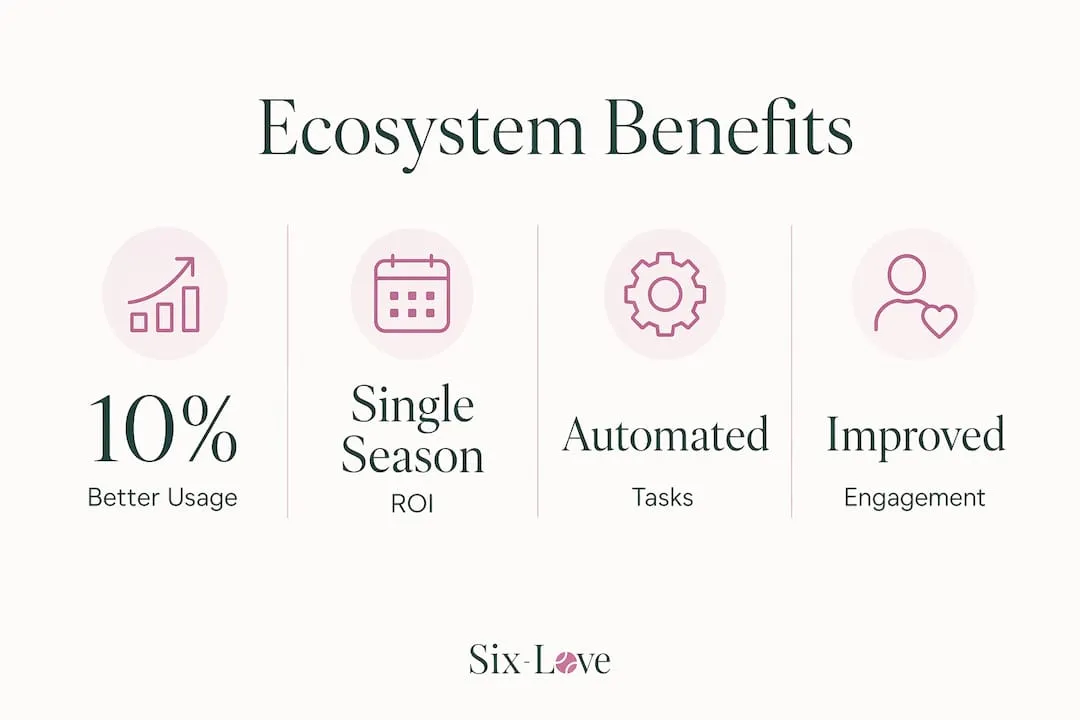
Fewer administrative bottlenecks also change how staff interact with customers. Chasing overdue membership dues, resolving double-booked prime-time slots, and untangling invoice errors wears down front-desk workers. When transactional tasks are automated, staff morale improves noticeably because employees spend their hours engaging with players at the desk instead of troubleshooting software glitches.
The Biggest Operational Mistake in Platform Selection
The costliest operational mistake in racquet sports is adopting software that is not built specifically for racquet facilities, especially surrendering player relationships to shared marketplace apps. Across our work with facilities, I frequently see clubs using shared marketplace apps where player data sits on a single app shared among many local clubs. That setup causes real friction because players lose club loyalty and easily move between venues, leading to a direct loss of revenue and forcing operators into tougher local competition where available courts, events, and booking prices are directly comparable all in one place.
When your court inventory sits on a regional aggregator alongside nearby competitors, members stop thinking about your facility and start booking based purely on open timeslots and price. Worse, those networks use your player lists to cross-sell competing facilities.
One of our newer clients in Spain had been relying heavily on Playtomic. When they wanted to organise a tournament, despite getting bookings for the event via the app, they then lost lots of the bookings just a few days before, as Playtomic was actively advertising a competing event in the area to the club's competitors. The result was a loss-making event and unhappy players, as the tournament was only half full. The event manager could not stop people from leaving because they did not have enough control over how registrations and cancellations were handled. When an operator hands player access over to an aggregator, they surrender control of their own member retention.
Comparing Bespoke Racquet Ecosystems and Generic Software
Generic management platforms like Mindbody or Zen Planner are designed for commercial gyms and yoga studios, meaning they fail to handle the daily realities of racquet facilities. A health club platform understands monthly gym memberships, but it cannot handle four-player split payments for a 90-minute padel match, enforce tennis rating caps on social leagues, or coordinate automated court lighting systems.
Bespoke platforms like Six-Love build sport-specific logic directly into the software architecture. The differences between bespoke systems, generic platforms, and shared marketplaces dictate how much control an operator retains over daily revenue and player data.
| Feature & Operational Criteria | Bespoke Racquet Ecosystem | Generic Club Software | Public Marketplace App |
|---|---|---|---|
| Sport-Specific Booking Rules | Native support for split payments, 4-player padel check-ins, and match levels | Limited; requires manual workarounds for partner matching and court duration | Basic court booking only; lacks deep club configuration rules |
| Member Data Ownership | 100% owned by the club; member records stay private | Owned by the club, but locked within rigid generic database fields | Shared with the platform; used to cross-market rival facilities |
| Branding & Member Portal | Custom club branding across mobile and web interfaces | Generic templates with minimal custom styling options | Third-party platform branding that minimizes your club identity |
| Event & Tournament Logic | Built-in brackets, round-robins, and dynamic waitlists | Requires separate third-party tournament software | Basic event listings with limited cancellation controls |
| Revenue Protection | Direct merchant accounts with zero marketplace commission | Standard processing fees with fixed billing cycles | High transaction commissions and competitive court price matching |
Managing Software Transition and Staff Buy-In
The common assumption that switching to an integrated ecosystem requires an impossible operational overhaul stems from vendor miscommunication. Vendors often pretend the friction is purely technical, when in reality, our onboarding team handles the vast majority of the data migration and setup heavy lifting ourselves. The transition isn't painless, but it fails or succeeds on staff buy-in rather than database complexity.
When we onboarded The Bay Racquets Club to our software, they were running entirely on manual spreadsheets, WhatsApp coordination, and disconnected accounting tools. Across our migration window, we had their core schedule and member database live in under a week. Within three months at The Bay Racquets Club, about 80 percent of their members shifted to booking directly through the app. That transition cut administrative overhead down dramatically while pushing court utilization higher.
On our onboarding volume, most front-desk staff, coaches, and players get comfortable with the interface within a single day of active use because the workflows are built around how courts are actually booked and paid for.
If you manage a busy racquet facility with two or more courts and find your staff trapped under spreadsheets, manual phone confirmations, and billing reconciliations, an integrated ecosystem is the operational baseline you need. For single-court community spaces with minimal booking volume, a basic paper ledger might suffice. But commercial clubs looking to protect their member base and optimize court revenue need a platform built specifically for the sport they host.
What to Do Before You Upgrade Your Club Software
If your club runs two or more courts and you are still untangling WhatsApp threads, paper schedules, and billing spreadsheets, stop patching your tools together and move to a unified platform. Commercial facilities that rely on off-the-shelf calendars or shared marketplace apps are quietly bleeding revenue and surrendering their player data to third parties. Look for a system built specifically for racquet sports rather than trying to force a generic gym app to handle split doubles payments and court lighting.
- Audit your current stack: Count how many separate apps, spreadsheets, and messaging groups your staff uses every day to manage bookings.
- Protect your member data: Refuse marketplace apps that share your player lists with competing clubs down the road.
- Test the sport-specific logic: Verify that any platform you evaluate can handle four-player split payments, dynamic pricing, and match-level rules natively.
FAQ
What is a club management ecosystem?
A club management ecosystem connects court reservations, member accounts, recurring dues, and tournament schedules inside one platform.
Why do racquet sports clubs need sport-specific software?
Generic tools lack the logic required for variable court durations, lighting automation, and split payments between doubles partners in tennis, padel, and pickleball.
What financial gains come from consolidating club operations?
When a small facility in Ireland consolidated its bookings into a unified platform, administrative work dropped by over 30 hours weekly while overall facility use climbed by 8 to 10 percent.
How do self-service portals improve member retention?
Self-service portals let members update payment methods, track billing histories, and book courts without front-desk intervention.
What is the primary risk of using shared marketplace apps?
Shared apps store player data across multiple competing venues, eroding club loyalty and making it easier for members to play elsewhere.