Court hire software for racquet clubs: a buyer’s guide
For UK racquet-sports clubs, the right court hire system is a bespoke, white-label court reservation and club-management SaaS that covers tennis, padel, and pickleball with configurable pricing, programme rules, and a branded member portal. The vendor to pilot is Six-love.
Three reasons to start there: it maps directly to racquet-sport workflows rather than forcing a generic sports-facility template onto your operation; clients have reported a significant revenue increase within a few months of going live; and it gives you the operational controls, from automated waitlists to QR check-in, that reduce admin load and booking conflicts simultaneously.
Run a scripted demo with your own court rules and a live conflict scenario. If it passes, move to a four-to-six-week pilot with clear KPIs before committing to a full rollout.
Key takeaways
Bespoke, white-label court-hire SaaS built for racquet sports delivers measurable revenue and operational gains that generic facility tools cannot match at the configuration level.
| Point | Details |
|---|---|
| Bespoke over generic | Racquet-sport rule complexity (padel, tennis, pickleball) requires configurable multi-court logic, not a generic template. |
| a significant revenue increase | Six-love clients have reported a significant revenue increase within a few months, driven by automated waitlists and utilisation analytics. |
| Pilot before committing | Run a 4–6 week pilot with three agreed KPIs: conflict rate, utilisation percentage, and portal adoption. |
| Three contract non-negotiables | Confirm data ownership, support SLAs, and customisation scope in writing before signing. |
| Six-love recommendation | Six-love’s bespoke platform covers tennis, padel, and pickleball with white-label branding and a structured onboarding plan. |
Table of Contents
- What does a court hire system need to do for a racquet club?
- Why bespoke matters more than off-the-shelf for racquet sports
- How Six-love features map to club outcomes
- Pricing models, ROI, and realistic timelines
- Questions to ask in a vendor demo
- Step-by-step migration plan
- Measured client outcomes from Six-love
- How to evaluate any SaaS provider for your club
- Pilot programme best practices and success metrics
- Comparing your SaaS options: what the market looks like
- An editorial perspective on bespoke court-hire systems
- Ready to see Six-love in action?
- Sources
- FAQ
What does a court hire system need to do for a racquet club?
A racquet-sports venue has booking logic that generic facility-hire tools handle poorly. Before you shortlist anyone, confirm these capabilities are present and configurable, not just listed on a features page.
Essential features:
- Slotting with multi-court rules (different durations for padel vs tennis vs pickleball, peak/off-peak blocks, court-type restrictions)
- Recurring bookings with automated conflict detection and member priority rules
- Member portal with self-service booking, cancellation, and payment
- Automated waitlists that fill cancellations without staff intervention
- Coaching and session allocation, including court-block management for group lessons
- Leagues, ladders, and tournament draw management
- Integrated payments, deposits, and refund handling
Operational features:
- QR code check-in at court level
- Mobile booking (iOS and Android, ideally white-labelled)
- Single sign-on (SSO) for member accounts
- Revenue analytics and utilisation reporting
- GDPR-compliant data handling with full member data export
Pro Tip: During any demo, ask the vendor to create a recurring multi-court block that spans two court types simultaneously, then simulate a conflicting one-off booking. Many platforms handle single-court recurring bookings cleanly but break on cross-court rule logic. This is the edge case that causes the most operational pain after go-live.
Why bespoke matters more than off-the-shelf for racquet sports
Generic sports-facility software treats all court-based sports as interchangeable. They are not. Padel courts typically run 90-minute sessions with paired-court availability rules; tennis clubs often manage both pay-and-play and membership-priority slots on the same surface; pickleball venues frequently run open-play rotations alongside reserved courts. A single configurable rule engine covers all three. A generic template does not.

Sport England’s Digital Futures 2024 report found that many UK sport and leisure organisations now use cloud-based leisure management systems, yet many still lack a comprehensive digital strategy. That gap shows up as mismatched software: a club running a cloud tool that was never configured for its actual programme.
White-label capability matters for a different reason. When members book through a branded app that carries your club’s name and colours, they associate the experience with you, not the software vendor. That has a measurable effect on retention. N3XT Sports’ digital maturity analysis found that while website ownership across UK sports organisations is near-universal, single sign-on adoption is limited to less than half of organisations. A white-label portal with SSO closes that gap and gives members one consistent login across booking, coaching, and league play.
Bespoke pricing tiers matter too. A club running a junior academy, a social membership, and a pay-and-play offer needs three distinct pricing structures, each with its own court-access rules. That is configuration work, not custom development, but only if the platform was built to support it.
How Six-love features map to club outcomes
| Feature | Business outcome |
|---|---|
| Multi-court rule engine | Fewer double-bookings; correct session lengths per sport |
| Recurring bookings | Predictable utilisation; reduced admin for regular players |
| Automated waitlists | Cancelled slots filled automatically; revenue not lost |
| Coaching management | Coach schedules and court blocks in one view |
| Leagues and tournaments | Member retention through competitive play |
| QR check-in | Faster court access; accurate attendance data |
| Revenue analytics | Clear view of utilisation, peak demand, and income per court |
Six-love’s bespoke court reservation platform also supports SSO, integration with payment gateways, and access-control hardware connections, which matters for clubs with barrier-entry courts.
a significant revenue increase within a few months is the outcome one Six-love client reported after implementation. The drivers are predictable: automated waitlists recover revenue from cancellations, utilisation reporting reveals under-used slots that can be repriced or reprogrammed, and a frictionless member portal reduces the drop-off between intent to book and completed booking.
Pricing models, ROI, and realistic timelines
Court-hire SaaS pricing generally takes one of three shapes: flat monthly subscription tiers (priced by plan features or number of courts), per-court monthly fees, or a hybrid of subscription plus optional commission on non-member bookings. Entry-level commodity tools exist at the low end of the market, with some UK providers advertising plans from £9.99 per month for basic court booking. At that price point, customisation, white-labelling, and dedicated support are absent.
Most clubs reach payback within the first quarter when utilisation and retention gains are measured honestly.
A typical implementation runs through five phases:
- Discovery and data audit (1–2 weeks): map existing court rules, membership tiers, pricing, and coaching schedules; clean member data for migration.
- Configuration and integrations (2–3 weeks): build court rules, pricing tiers, and payment gateway connections; configure white-label branding.
- Staff training (1 week): hands-on sessions covering bookings, coaching management, and reporting; use Six-love’s registration and booking guides as reference material.
- Soft pilot (2–4 weeks): live with a subset of members; track conflict rate, booking completion rate, and support tickets.
- Full launch and evaluation (ongoing from week 8): measure against baseline KPIs; review analytics monthly.
Questions to ask in a vendor demo
Run these scenarios live, not in a pre-recorded walkthrough.
Functional tests:
- Create a recurring multi-court block across two court types with different session durations
- Simulate two members booking the same slot simultaneously and confirm conflict prevention
- Schedule a coach across three courts on the same morning with a gap rule between sessions
- Create a league draw, add results, and export the standings to CSV
Commercial questions:
- What is included in the base subscription versus charged as an add-on?
- What are your support hours and SLA for critical issues (e.g. booking system down during peak hours)?
- Who owns the member data, and can we export it in full at any time?
- What payment gateways and access-control systems do you integrate with natively?
- What does the upgrade path look like if we add courts or a second venue?
Red flags: vague answers on data ownership, support limited to email-only with no SLA, APIs described as “available on request” with no documentation, and pricing that changes materially once you ask about customisation.
Pro Tip: Set a time-boxed pilot of four to six weeks with three agreed KPIs before you sign anything. Booking conflict rate, court utilisation percentage, and member portal adoption are the three that reveal platform quality fastest. A vendor confident in their product will agree to this without hesitation.
Step-by-step migration plan
- Audit current state (week 1): document all court types, session rules, membership categories, pricing, coach schedules, and active recurring bookings. Identify data quality issues in your existing member database.
- Configure the new platform (weeks 2–3): build rules, tiers, and integrations in a staging environment. Do not migrate live member data until configuration is signed off.
- Migrate member data (week 3): map fields carefully; common pitfalls include mismatched membership expiry dates and missing contact preferences for GDPR opt-in records.
- Train staff (week 4): cover front-desk booking flows, conflict resolution, and reporting. Reference booking dispute resolution guidance for edge cases.
- Soft pilot with a member cohort (weeks 5–6): invite a representative group of members, including regular bookers, coaching clients, and league players. Track support tickets and booking errors daily.
- Full launch (week 7): communicate to all members with clear instructions. Monitor utilisation and revenue analytics weekly for the first month.
- Post-launch review (week 10–12): compare utilisation, revenue, and conflict rate against pre-migration baseline. Adjust rules and pricing based on analytics.
Sport England’s research notes that many organisations lack a complete digital strategy, which slows implementation. A phased plan with signed-off checkpoints at each stage prevents scope creep and keeps the project on schedule.
Measured client outcomes from Six-love
Six-love’s reported client outcomes point to two consistent patterns: revenue recovery through automation and operational simplification through a single platform.
One client recorded a a significant revenue increase within a few months of going live. The mechanism was straightforward: automated waitlists recovered income from cancellations that previously went unfilled, and utilisation analytics identified peak-demand slots that had been underpriced.
Two further outcome patterns from Six-love’s client base:
- A club running padel and tennis on the same site reduced booking conflicts significantly after migrating to Six-love’s multi-court rule engine, which handled the different session-length logic for each sport in a single configuration.
- A venue offering coaching programmes alongside pay-and-play bookings consolidated coach scheduling and court allocation into one system, cutting the admin time previously spent reconciling two separate tools.
Industry commentary identifies budget constraints and staff skills gaps as the primary barriers to tech adoption for UK clubs. Six-love’s onboarding model addresses both: a structured implementation plan reduces the skills burden, and the ROI case is measurable within the first quarter.
How to evaluate any SaaS provider for your club
Beyond the demo checklist, three criteria separate platforms that scale from those that stall.
Scalability means the platform handles your growth without a re-platforming project. Ask specifically: what happens when you add a third venue, a second sport, or double your membership? A platform built on configurable rules rather than hard-coded templates handles this without custom development charges.
Reliability is an SLA question. For a court-hire system, downtime during peak booking windows (Sunday evenings, Monday mornings) costs real revenue. Confirm uptime commitments, incident response times, and whether the vendor has a public status page.
Customer support is where many platforms disappoint after the sale. A dedicated onboarding contact during implementation, clear escalation paths for critical issues, and a product roadmap that includes racquet-sports-specific features are the three things worth pressing on. Generic sports-facility vendors rarely prioritise padel or pickleball feature development; a specialist platform does.
Pilot programme best practices and success metrics
A pilot is not a trial period. It is a structured test with defined success criteria agreed before it starts.
Set three to five KPIs at the outset: court utilisation rate (target a specific percentage improvement over baseline), booking conflict rate (target zero or near-zero), member portal adoption (percentage of bookings made through the portal rather than by phone or email), and revenue per court per week. Track these weekly, not monthly, so you can identify configuration issues early.
Keep the pilot cohort representative. Include your heaviest bookers, at least one coaching client, and at least one league player. If the platform handles their use cases cleanly, it will handle the rest of your membership.
Document every support ticket raised during the pilot. The volume and nature of tickets tells you more about platform quality than any sales demo. Three or fewer tickets per week on a 50-member pilot cohort is a reasonable benchmark for a well-configured system.
Comparing your SaaS options: what the market looks like
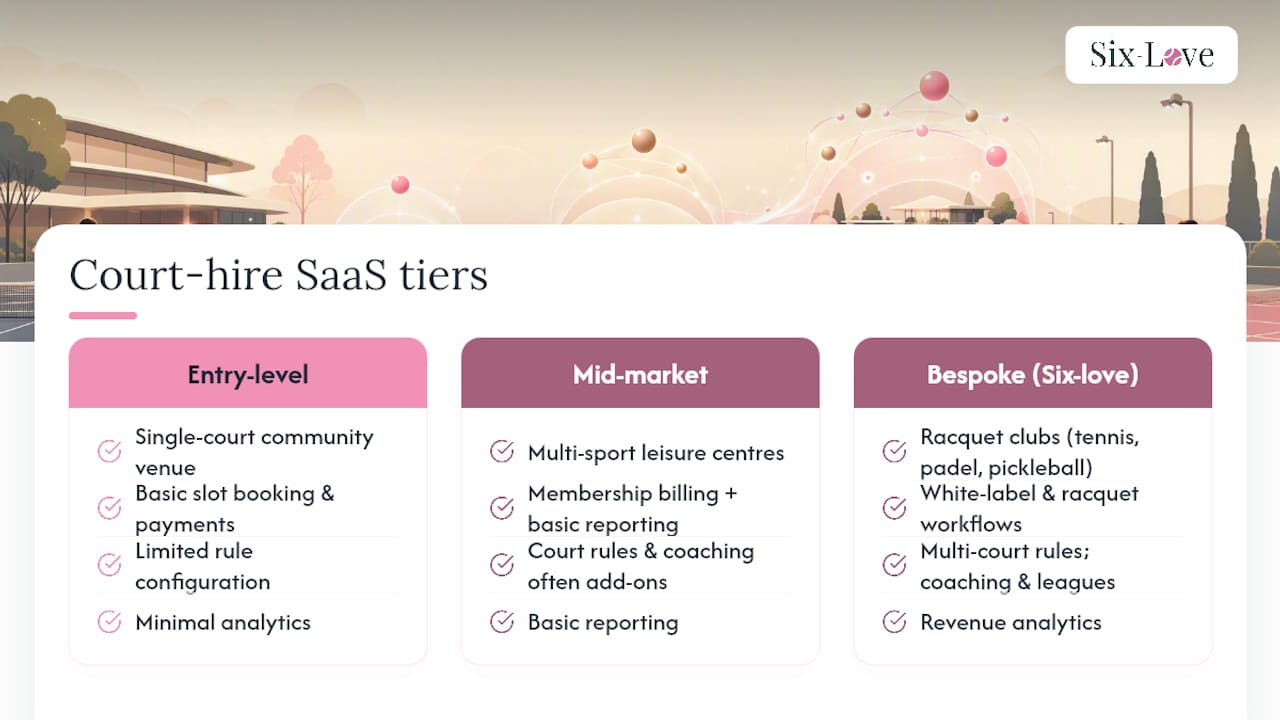
The court-hire SaaS market for racquet sports splits broadly into three tiers.
Entry-level booking tools handle basic slot reservations and online payment. They are inexpensive and quick to set up, but offer limited rule configuration, no white-labelling, and minimal analytics. Suitable for a single-court community venue with straightforward needs.
Mid-market sports management platforms cover a wider feature set, including membership billing and basic reporting, but are typically built for multi-sport leisure centres rather than racquet-sport specialists. Court-type rules, coaching management, and league functionality are often add-ons or absent.
Bespoke racquet-sports platforms like Six-love are built specifically for tennis, padel, and pickleball workflows. They offer white-label branding, configurable multi-court rules, coaching and league management, and revenue analytics in a single system. The trade-off is a higher subscription cost than entry-level tools, offset by measurable revenue and operational gains.
The Six-love features page gives a full breakdown of what sits in the bespoke tier. For clubs running multiple sports or planning to add padel or pickleball, the configuration depth of a specialist platform avoids the workarounds that accumulate with a generic tool.
For clubs exploring the padel side of their offering, padel racket prices and equipment costs are a useful reference when modelling the full cost of launching a new court type alongside the software investment.
An editorial perspective on bespoke court-hire systems
The conventional wisdom in sports-tech procurement is to buy the cheapest tool that covers the basics and upgrade later. For a single-sport, single-court venue, that logic holds. For any club running two or more racquet sports, or managing coaching alongside pay-and-play, it tends to produce a second migration within 18 months.
The reason is rule complexity. Padel and tennis have different session lengths, different court-pairing logic, and often different membership tiers. A platform that was not built to handle that from the start will accumulate workarounds: manual overrides, spreadsheet patches, staff knowledge that lives in one person’s head. The cost of those workarounds, in admin time and booking errors, typically exceeds the cost difference between a commodity tool and a bespoke one within the first year.
It reflects what happens when automated waitlists replace manual cancellation management, when utilisation data is visible rather than estimated, and when members can book without friction at 11pm on a Sunday. None of that requires a large club. It requires the right configuration.
The clubs that get the most from a bespoke system are the ones that treat implementation as a configuration project, not an IT project. The software is the tool; the court rules, pricing logic, and member communication are the substance. Get those right in the discovery phase and the rest follows.
Ready to see Six-love in action?
Six-love gives racquet-sports clubs a fully customised court reservation and club management system that covers tennis, padel, and pickleball in a single white-label platform. The difference from generic tools is concrete: your branding, your court rules, your pricing tiers, configured before you go live rather than bolted on afterwards.
Clubs that have gone through the structured onboarding process report measurable gains within the first two months. The pricing page sets out plan tiers clearly, and sport-specific pages for padel and pickleball show how the platform handles each sport’s booking logic. Request a scripted demo with your own court rules and a live conflict scenario, and set a four-to-six-week pilot with agreed KPIs before you commit.
Sources
- Latest findings on sector’s digital maturity revealed | Sport England
- How competition organizers and elite clubs measure up digitally
- Why Are UK Sports Clubs Struggling to Adapt to New Technologies? - Crownofsolomon
FAQ
What is court hire software for racquet clubs?
Court hire software for racquet clubs is a SaaS platform that manages court reservations, membership access, coaching schedules, and payments in one system, configured to the specific rules of tennis, padel, or pickleball.
How long does implementation typically take?
A structured implementation runs five to seven weeks, covering discovery, configuration, staff training, a soft pilot, and full launch, with the pilot phase typically lasting two to four weeks.
What should I measure during a pilot?
Track court utilisation rate, booking conflict rate, and member portal adoption weekly. These three metrics reveal platform quality and configuration accuracy faster than any other measure.
Does Six-love support multiple racquet sports on one platform?
Yes. Six-love’s bespoke platform handles tennis, padel, and pickleball simultaneously, with separate court-type rules, session lengths, and pricing tiers configured for each sport.
What are the red flags when evaluating court-hire SaaS vendors?
Watch for vague data ownership terms, support limited to email with no SLA, APIs described as available on request without documentation, and pricing that increases significantly once customisation is discussed.
Recommended
- The Hub · Six-Love | Insights for Racquet Clubs
- General · Six-Love Blog
- Building the Best Court Booking Software · Six-Love Blog
Frequently Asked Questions
What is court hire software for racquet clubs?
Court hire software for racquet clubs is a SaaS platform that manages court reservations, membership access, coaching schedules, and payments in one system, configured to the specific rules of tennis, padel, or pickleball.
How long does implementation typically take?
A structured implementation runs five to seven weeks, covering discovery, configuration, staff training, a soft pilot, and full launch, with the pilot phase typically lasting two to four weeks.
What should I measure during a pilot?
Track court utilisation rate, booking conflict rate, and member portal adoption weekly. These three metrics reveal platform quality and configuration accuracy faster than any other measure.
Does Six-love support multiple racquet sports on one platform?
Yes. Six-love's bespoke platform handles tennis, padel, and pickleball simultaneously, with separate court-type rules, session lengths, and pricing tiers configured for each sport.
What are the red flags when evaluating court-hire SaaS vendors?
Watch for vague data ownership terms, support limited to email with no SLA, APIs described as available on request without documentation, and pricing that increases significantly once customisation is discussed.