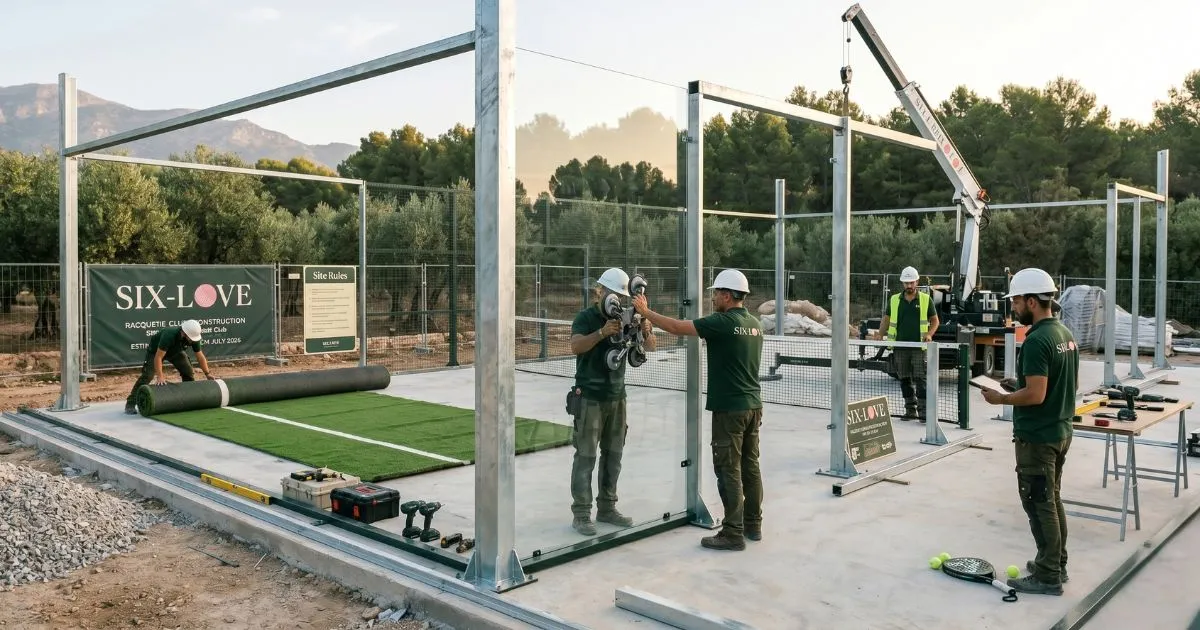
The global explosion of padel has turned many racquet sports enthusiasts into entrepreneurs. But before you can welcome players to your "Elite" facility, you need to answer the primary investment question: How much does it cost to build a padel court? In this guide, we break down the capital expenditure required to move from an empty plot to a revenue-generating club.
You will also want to ensure that everything us up to regulation. In the UK The LTA Padel Court Guidance is the go to reference. I have been involved with many racquets sports and clubs for over 30years, and since moving to Spain (the home of padel) have been working with multiple padel clubs to help improve their clubs using the Six-Love system.
Average Costs for Padel Court Construction (2026)
On average, the cost to build a single padel court ranges between €20,000 and €40,000. This variance depends heavily on whether you are installing an indoor or outdoor court, the quality of materials, and the extent of the necessary groundwork.
1. Groundwork and Foundations (€8,000 – €15,000)
Groundwork is often the most overlooked expense. A padel court requires a perfectly level 20m x 10m reinforced concrete slab. If your site requires significant excavation or drainage work, these costs can climb quickly.
2. The Court Structure and Glass (€10,000 – €18,000)
The "skeleton" of the court consists of galvanized steel frames and tempered glass panels (usually 10mm or 12mm thick). High-end "panoramic" courts, which offer better visibility for spectators and cameras, sit at the higher end of this price range.
3. Artificial Turf and Lighting (€3,000 – €7,000)
For an "Elite" feel, the quality of the turf is non-negotiable. Monofilament textures are the industry standard for professional play. Additionally, LED lighting systems are essential for maximizing evening booking revenue.
Hidden Costs of Starting a Racquet Club
Building the court is only half the battle. To turn your investment into a profitable business, you must account for:
Planning Permission & Architect Fees: Depending on your region, this can add months to your timeline.
Maintenance: Regular brushing of the turf and glass cleaning.
Management Tech: To ensure your courts are consistently occupied, you need an efficient padel court booking system that handles the "heavy lifting" of admin.
Maximizing Your ROI with Smart Management
Once the construction is finished, your goal is to achieve 100% court occupancy. The most successful clubs don't just wait for people to call; they use racquet sports club management software to automate the player experience.
By implementing features like padel tournaments using our software, you can organize social tournaments that fill four courts simultaneously, ensuring your investment pays for itself in record time.