
Empty courts kill revenue, yet most high-volume racquet sports complexes still handle fully booked peak slots with absolute passive resignation, making robust tennis club waitlist management an operational necessity in 2026. Across three decades on court and two years architecting sports club management systems, manual scheduling remains the single most persistent leak in racquets facility yield.
Court time is strictly perishable inventory. When a player drops out of a 6:00 PM court with two hours of notice, a static booking grid offers zero protection. An automated queue locks in replacement bookings within minutes, preserving court fees and food-and-beverage spend that would otherwise vanish the moment the court sits dark.
Defining the Queue in Racquet Sports Facility Operations
Tennis club waitlist management is an automated queue protocol that places overflow players onto a structured, chronological standby list whenever coaching clinics, social mixers, or peak court hire slots reach capacity. Instead of presenting players with a dead-end calendar grid when a 6:00 PM slot fills up, the software logs interested members into an active queue that triggers the moment an enrolled player cancels.
The system works as an active backfill engine. The moment a cancellation clears on the schedule, the platform evaluates the queue, identifies the next eligible participant based on club-defined rules, and dispatches a time-limited invitation. If that player declines or fails to respond before the window expires, the engine offers the spot to the next player down the line. The process runs unattended, eliminating the operational bottlenecks created when front-desk workers attempt to fill open courts manually.
Why Manual Scheduling Drains Club Yield and Staff Time
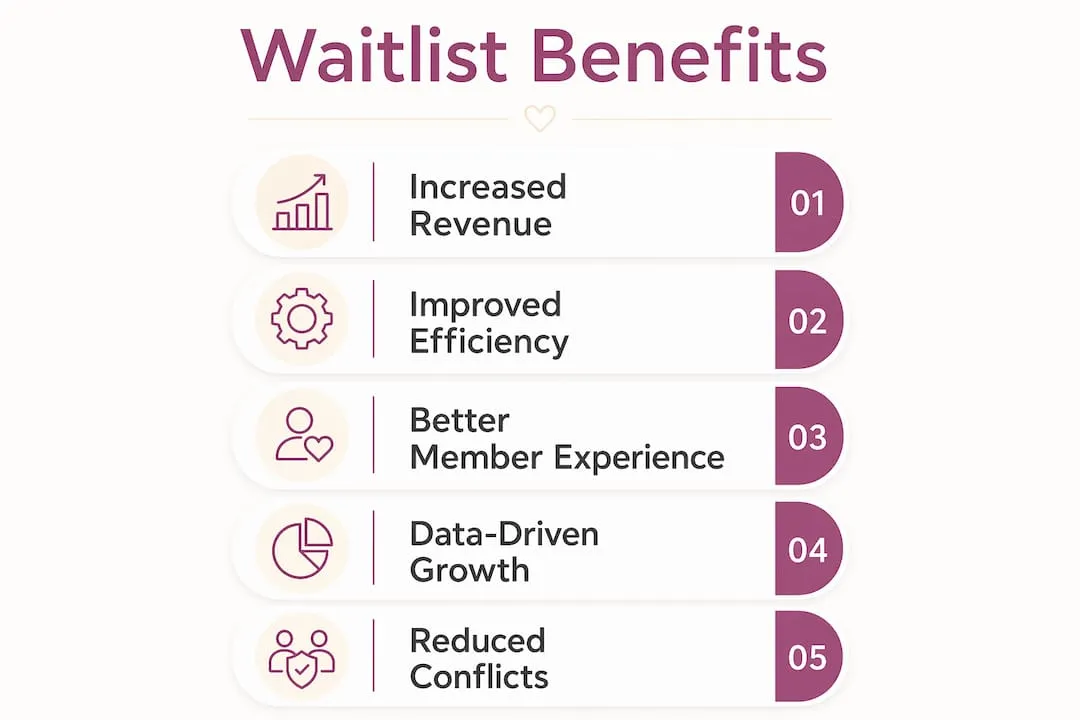
Prime evening court cancellations represent immediate, unrecoverable revenue loss: when a player withdraws from a 6:00 PM booking with only two hours of lead time, a static booking grid cannot alert substitute players quickly enough to prevent dark courts, diminished clinic headcount, and immediate pro-shop drop-off.

The burden falls disproportionately on coaching personnel. When high-demand squads experience morning-of cancellations, head professionals routinely spend between-lesson intervals sending ad-hoc messages to prospective alternates. This constant triage pulls coaches away from curriculum preparation and on-court instruction while introducing unnecessary latency into roster reconstitution.
The administrative cost compounds rapidly. In an operational analysis we completed for a popular padel and tennis club, manual administration, phone tag, and chaotic rescheduling consumed over 90 hours per week of staff time. That payroll went into chasing dropouts on paper clipboards, updating disconnected spreadsheets, and answering WhatsApp messages from members asking if an evening doubles slot had opened up.
When cancellations remain unfilled, the facility loses far more than the immediate court hire fee. Secondary spend disappears alongside court occupancy:
- Pro-shop retail volume: Lost foot traffic translates directly to fewer sales of ball cans, replacement grips, and restringing services before match play.
- Clubhouse hospitality margin: Unfilled courts mean empty bar stools, zero post-match food orders, and reduced cafe receipts from the four players who should have been on site.
- Coaching conversion pipeline: Empty squad slots break attendance momentum and reduce the warm leads that coaches convert into private instruction.
- True demand blindness: Paper sheets provide no telemetry on how many players wanted a court at 7:00 PM on Tuesday but walked away. Without digital queue logs, management lacks the hard metrics needed to price peak tiers, add clinics, or plan facility expansions.
Core Mechanics of Automated Queue Architecture
Running automated queues across tennis, padel, and pickleball facilities requires specialized infrastructure. Generic restaurant reservation widgets and basic retail points of sale like XEPOS cannot map complex, codependent sports assets. Similarly, open-source code scripts like the CourtPin repository on GitHub lack the engineering required to handle multi-coach academy packages, dynamic court lighting integrations, or high-volume standby queues. Off-the-shelf booking tools such as Anolla or Playtomic often disconnect internal member records from court booking grids, pushing staff back into ad-hoc WhatsApp groups.
A dedicated queue architecture relies on four operational mechanisms:
- Timestamp integrity: When club directors rely on automated systems that fail to preserve strict chronological order, friction between members spikes immediately. Standby queues must strictly enforce first-in, first-out (FIFO) scheduling based on immutable join timestamps. When inventory releases, the platform issues an automated dispatch with an exclusive reservation window. Exposing dynamic queue position directly inside the member portal eliminates front-desk dispute arbitration regarding priority order.
- Response expiration windows: Set strict countdown timers on notifications. For clinic spots opening days ahead, a 24-hour response window gives players adequate time to confirm. For day-of cancellations occurring four hours before first serve, the system must compress the offer window to 15 or 30 minutes before bumping down to the next player, ensuring the spot fills before match time.
- Skill-level gatekeeping: A queue cannot treat all members as interchangeable numbers. Industry frameworks like the USTA's Programming Waiting Lists highlight the value of structured rosters, but club systems must enforce NTRP or custom club rating limits automatically. If an advanced player withdraws from a 4.5 competitive match, dropping an unrated beginner into that vacancy ruins the match for the other three players.
- Frictionless payment commits: Financial authorization must be captured at queue entry. By integrating native payment processing like Stripe, the engine can pre-authorize a player's credit card or verify their package session balance the moment they join the standby line. When a spot opens and the member accepts, the platform completes the transaction instantly without manual invoicing.

Contrasting Legacy Workflows with Modern Mobile Flow
The operational contrast between traditional desk scrambling and modern app-based queue management determines whether peak cancellations turn into dead courts or guaranteed revenue.
| Operational Dimension | Legacy Manual Dispatch | Automated Mobile Architecture |
|---|---|---|
| Trigger Mechanism | Desk staff reads an incoming cancellation email or takes a voicemail. | Member cancels directly in the app, instantly alerting the waitlist engine. |
| Notification Method | Desk staff manually dials phone numbers or sends WhatsApp group blasts. | Push notification and automated email dispatched to the top-ranked standby player. |
| Fulfillment Velocity | 1 to 4 hours of phone tag, frequently resulting in a dark court. | 5 to 30 minutes, governed by an automated expiration countdown timer. |
| Queue Fairness | Subjective, relationship-driven, and prone to member disputes. | Immutable timestamp audit trail visible to both player and administration. |
| Payment Collection | Chasing card numbers over the counter or billing retroactively. | Instant charge via stored Stripe tokens or deduction of package credits. |
| Coach Involvement | Coach texts clients between lessons to patch together an evening squad. | Fully detached; the roster self-heals while the coach stays on court. |
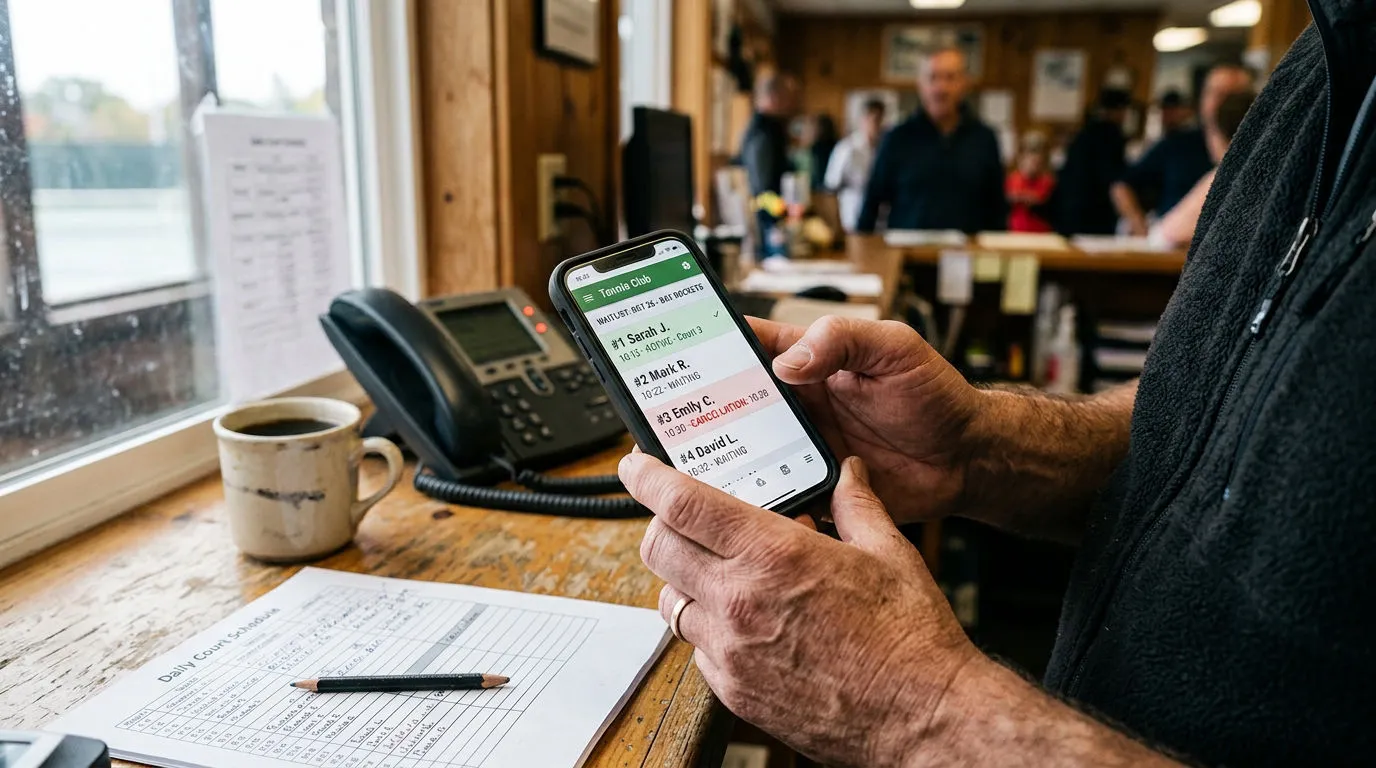
Transitioning away from manual clipboards produces measurable operational returns. At Bay Rockets Club, our booking system went live in early 2026 after years of handling everything manually. The admin team worried that moving to an app would alienate members who liked calling the front desk to chat. Within three months of rolling out the Six Love platform, however, 80 percent of court bookings had shifted directly to the new app. Members who still prefer calling the club can certainly still do so, but the automated workflow cut our administrative workload by more than 80 percent.
Overcoming Adoption Friction and Managing Transitions
Club operators frequently cite high-touch phone service as a core retention driver, viewing self-service automation as an impersonal compromise. That dichotomy is false. Modern facility platforms allow front-desk staff to operate as concierges who log telephone requests into the digital queue console on behalf of non-digital members. Observational data across pilot implementations indicates that even in traditionally resistant memberships, over 80 percent of players migrate to native mobile booking within 90 days once court availability transparency becomes apparent.
To modernize facility operations without causing friction at the front desk, implement the change through concrete operational steps:
- Maintain phone concierge access: Do not cut off legacy phone lines on day one. Allow front-desk staff to enter telephone reservations directly into the digital console on behalf of older members while guiding the broader membership toward mobile self-service.
- Run a dual-track transition period: Introduce the waitlist protocol on high-demand coaching squads first. Coaches will welcome the relief from scrambling between lessons, and competitive players will appreciate transparent queue positioning.
- Tighten cancellation rules: Pair automated queues with a firm cancellation policy. If members know an empty spot will be claimed instantly by a standby player, they are more willing to cancel early rather than no-showing.
- Audit recovered hours weekly: Track the administrative time recovered and revenue recaptured through filled cancellations. Sharing these metrics with board members and staff reinforces system adoption across the entire facility.
What to Do Next With Your Courts
Automated queue management pays for itself the first week a 6:00 PM squad self-heals instead of sitting dark while a coach scrambles on a clipboard. Facilities do not need to eliminate phone lines or alienate long-time members to achieve efficiency. Modern queue software captures perishable court fees, protects coach productivity, and gives players transparent access to the courts they want to play on.