
When running a tennis, padel, or pickleball club, relying on manual calendar sheets for weekly coaching squads and social mix-ins creates an endless administrative grind. Front desk staff spend their best morning hours fielding WhatsApp messages, cross-referencing paper sheets, and manually re-entering Tuesday evening doubles groups into a digital diary. The process creates friction for players and burns payroll on routine desk administration that modern software handles automatically.
The operational fix is implementing recurring booking features that automatically renew court reservations, roll participant rosters over, and handle cancellations without staff intervention. On our platform data at Six Love, moving to automated recurring reservations lifts client retention by 30 to 40% while turning casual walk-ons into committed weekly players.

Automating recurring court demand does far more than clean up the front desk ledger. It locks in court utilization across racquet facilities months in advance, providing the predictable baseline income required to plan court resurfacing, hire coaching staff, and expand programming with genuine confidence.
What is a Recurring Booking Feature in Racquet Sports?
When building Six Love, one capability I pushed for early was the ability to handle reservations that recur every week or month without ongoing staff intervention. In simple terms, a recurring booking feature lets an administrator set up a schedule once, whether for regular club mix-ins, weekly junior coaching squads, or monthly tournaments, and lets the platform generate those court allocations automatically.
On our admin load, that automated generation strips away hours of repetitive calendar work, because nobody has to sit down and manually reserve courts for the same members every single Monday. Participant lists roll over from week to week while handling individual cancellations and temporary pauses whenever a member steps away for travel or injury. That keeps court sheets full without turning daily club management into a full-time scheduling desk.
A standard ad-hoc reservation tool behaves like a one-off digital ledger: a player selects 18:00 on Thursday, pays, and leaves the calendar completely blank for the following week. An automated recurring system establishes a persistent reservation rule. The slot remains assigned to that player, squad, or clinic until an explicit rule ends it, such as a set session count, a season-end cutoff date, or an intentional member withdrawal.
Why Recurring Scheduling Stabilises Revenue and Drives Retention
A racquet club loses money whenever a regular player slips into becoming an occasional walk-on. A casual player who books sporadically is easy to lose to bad weather, schedule conflicts, or competing social plans. In contrast, a player locked into an 18:30 Tuesday evening padel slot builds their weekly routine directly around that court session.
Securing those standing commitments lifts client retention by 30 to 40% compared to clubs running purely ad-hoc reservation models. Habit drives sports club viability. Increasing customer retention by just 5% can boost profits by 25 to 95%, and recurring bookings underpin that retention by turning court attendance into an automated habit rather than a weekly purchase decision. When booking requires active manual effort every seven days, players skip weeks when work gets busy or booking windows open while they are driving. Once a player misses two consecutive weeks, their likelihood of dropping off completely climbs rapidly.
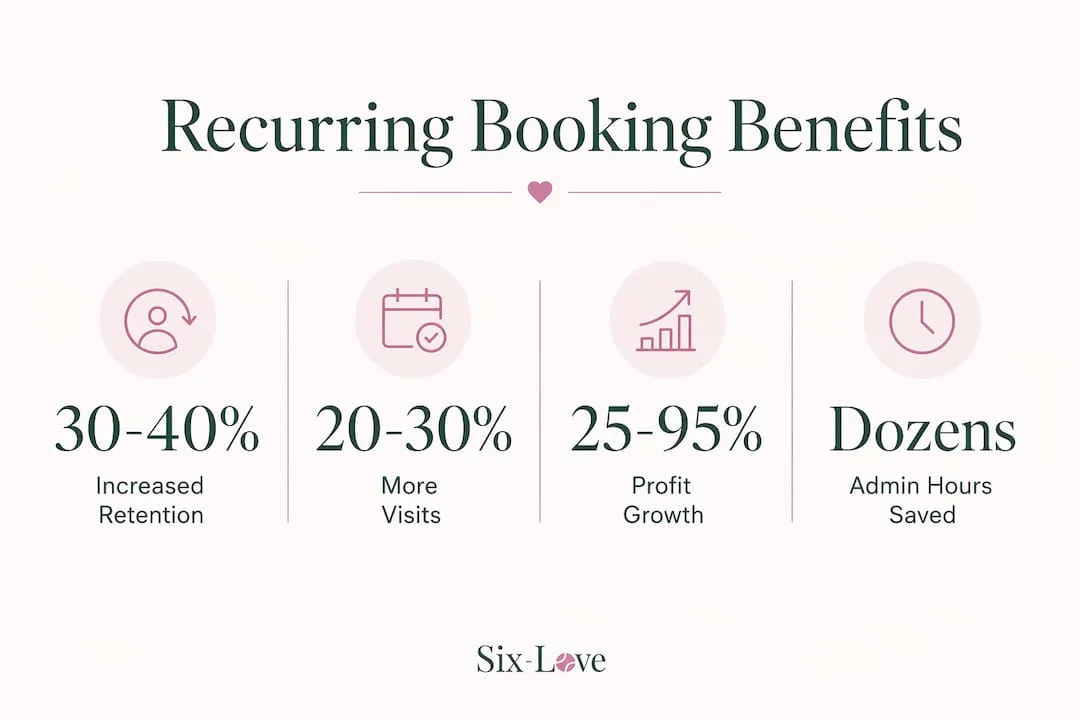
The operational gains show up immediately in court utilization. Racquet facilities implementing structured standing reservations observe a visit frequency increase of 20 to 30%, which directly suppresses no-show rates. When courts are reserved on a recurring basis, players treat their slot as a fixed appointment rather than an optional leisure activity.
Predictable scheduling also transforms club cash flow. Facilities that lock down 40 to 60% of their monthly court hours via recurring reservations can accurately forecast revenue cycles before a calendar month starts. Published data shows that service businesses integrating automated booking systems achieved average year-on-year growth of 37%, with some operations reporting revenue gains up to 120%. On our own platform metrics, Six Love clients have reported an average 22% revenue increase within just two months of implementation, because courts that once sat vacant during transitional daytime hours get filled by predictable recurring blocks.
Comparing Scheduling Approaches Across Club Operations
Clubs generally run their facilities through one of three operational models: manual paper sheets and Excel files, generic tools like Google Calendar or basic gym software, or dedicated racquet booking engines. Each method carries direct trade-offs in front-desk labour, booking friction, and roster reliability.
| Operational Factor | Manual Spreadsheets & Paper | Basic Calendar Software | Automated Recurring Booking Features |
|---|---|---|---|
| Initial Setup Time | Low (5 to 10 minutes to draft a sheet) | Moderate (manual entry per single date) | Fast (one-time schedule setup in ~5 minutes) |
| Weekly Admin Overhead | 5 to 10 hours lost to phone calls and rosters | 3 to 6 hours manually duplicating slots | Near zero; rosters and sessions roll over automatically |
| No-Show Tracking | Unreliable; relies on front-desk memory | Spotty; requires manual check-in marks | Automated; triggers reminders and flags chronic absentees |
| Schedule Rescheduling | High friction; requires phone or text chains | Clunky; requires deleting and recreating bookings | Self-service; players pause or shift dates without losing standing slots |
| Revenue Predictability | Poor; highly vulnerable to week-by-week drop-offs | Moderate; requires manual re-invoicing | High; predictable recurring baseline locked months in advance |
Recurring bookings save dozens of administrative hours monthly by removing human scheduling errors and manual back-and-forth. Relying on manual tools forces staff to spend their shifts fielding calls and resolving court conflicts, whereas modern automated engines treat the entire schedule as a persistent, self-managing workflow.
Real-World Mechanics: Scheduling Seasonal Blocks and Managing Exceptions
A club local to me, Bel Air Tennis Club, used to schedule recurring events manually almost every single day. When speaking to their admin team, they told me it takes them approximately one hour every morning to check attendees, send invites, and book courts for the week ahead. When we showed them how the Six Love system handles recurring events, setting up a block in five minutes that requires zero day-to-day management afterwards, they adopted it immediately.
Seven hours a week spent re-entering names into court grids is a terrible drain on club payroll. Over a twelve-week seasonal term, that represents more than 80 hours of administrative work dedicated purely to typing names into daily calendars.

The biggest technical hurdle in automating recurring blocks is managing member exceptions without wrecking the master series. In any three-month coaching block, players travel, fall ill, or need to swap court assignments. Basic scheduling scripts handle this poorly: if an administrator modifies a player's booking on week four, the system often deletes the entire twelve-week recurring sequence.
Effective recurring booking systems offer flexible recurrence rules including weekly, biweekly, monthly, and custom intervals, alongside clean end conditions like session counts or fixed dates. They must allow members to skip or reschedule individual sessions without cancelling the entire series. We introduced self-service member match and coach rescheduling to solve this directly. Instead of calling reception, a player clicks reschedule in their profile, and the system displays available alternative slots while checking coach availability. That single mechanism prevents cancellations and keeps the court populated.
Some members initially tell us they prefer doing it manually because they enjoy a hands-on routine. At Six Love, we completely disagree with this approach. Every club where we have introduced recurring booking features has found the system significantly better both for administration and for users who value their time.
When we introduced our platform to Estepona Pickleball Club, the facility recorded a 110% revenue increase in under five weeks. The reason was straightforward: players could see available courts, tournaments, group events, and coaches at any hour, or find a partner to play with, without waiting for the desk to open or calling staff.
Practical Next Steps for Implementing Automated Bookings
Transitioning a busy racquet sports facility from manual booking routines to an automated recurring system requires a structured operational sequence. Attempting to shift every coaching squad, league, and court sheet overnight confuses members and overwhelms reception staff.
Integrating booking cadence with payment models reduces manual reconciliation and administrative workload. If clinics run in four-week blocks, charge in four-week blocks. If social mix-ins recur weekly, set weekly automated debits. Mismatched billing cycles create reconciliation headaches and undermine the automation benefits you are working to achieve.
Follow these steps to phase in automation cleanly:
- Audit current recurring programs. Identify your fixed weekly commitments, such as coaching groups, weekend junior squads, and standing member match contracts, and calculate the weekly hours staff spend maintaining these lists.
- Standardize cancellation and pause rules. Establish how many hours before a session a player can skip without penalty, whether skipped sessions convert to credits, and how many pauses a member can take per season.
- Pilot the system on one court type or group. Launch the automated recurring system exclusively on a discrete group, such as a Wednesday night padel league or a Saturday morning beginner pickleball clinic, for three weeks to iron out communication hiccups.
- Synchronise payment with the recurring schedule. Align billing cycles directly with booking frequency by establishing per-session charging, prepaid session packages, or subscription billing.
- Turn on automated player reminders and calendar syncing. Configure automated SMS or email notifications to deliver 24 hours before each scheduled court time, and enable calendar syncing with Google Calendar and Apple Calendar so members see upcoming games on their mobile phones.
- Migrate remaining adult leagues and general court allocations. Once the pilot demonstrates reduced desk friction, migrate standing member contract hours and prime-time recurring games across all courts.
Clubs that invest the effort into standardizing their schedules eliminate morning desk logjams and lock in stable court occupancy. If you operate courts with consistent weekly traffic, manual booking sheets are costing you hours every single week.
What to Do With Your Court Calendar Next
Migrating a racquet sports facility to automated recurring reservations takes the front desk out of the administrative loop and secures the steady baseline income every club needs to survive seasonal dips. If your staff are still spending their mornings cross-referencing paper rosters or fielding WhatsApp messages for standing matches, the fix is not hiring more front desk help. It is locking down a persistent scheduling engine that lets players manage their own slots while keeping your court use high.
The smoothest path is auditing your fixed weekly coaching blocks first, pinning down your cancellation cutoffs, and testing the automation across a single league before converting your entire facility.
FAQ
What is a recurring booking feature in a racquet club?
It is an automated reservation system that schedules repeat court allocations and rolls participant rosters over week after week without staff intervention.
How do standing reservations impact club retention rates?
Standing reservations secure specific times on a player's calendar weeks ahead, removing the weekly friction of manual booking and turning court time into an uninterrupted personal habit that cuts seasonal churn.
Can players pause or skip a single session in a series?
Yes.
Why do manual calendars drain club profitability?
Front desk staff lose hours to phone calls and paper cross-referencing while courts sit empty during unmanaged transitional slots that automation fills.
How fast do clubs see financial returns from scheduling automation?
Clubs typically see cash flow stabilize during their first billing cycle as recurring direct debits capture fees upfront.