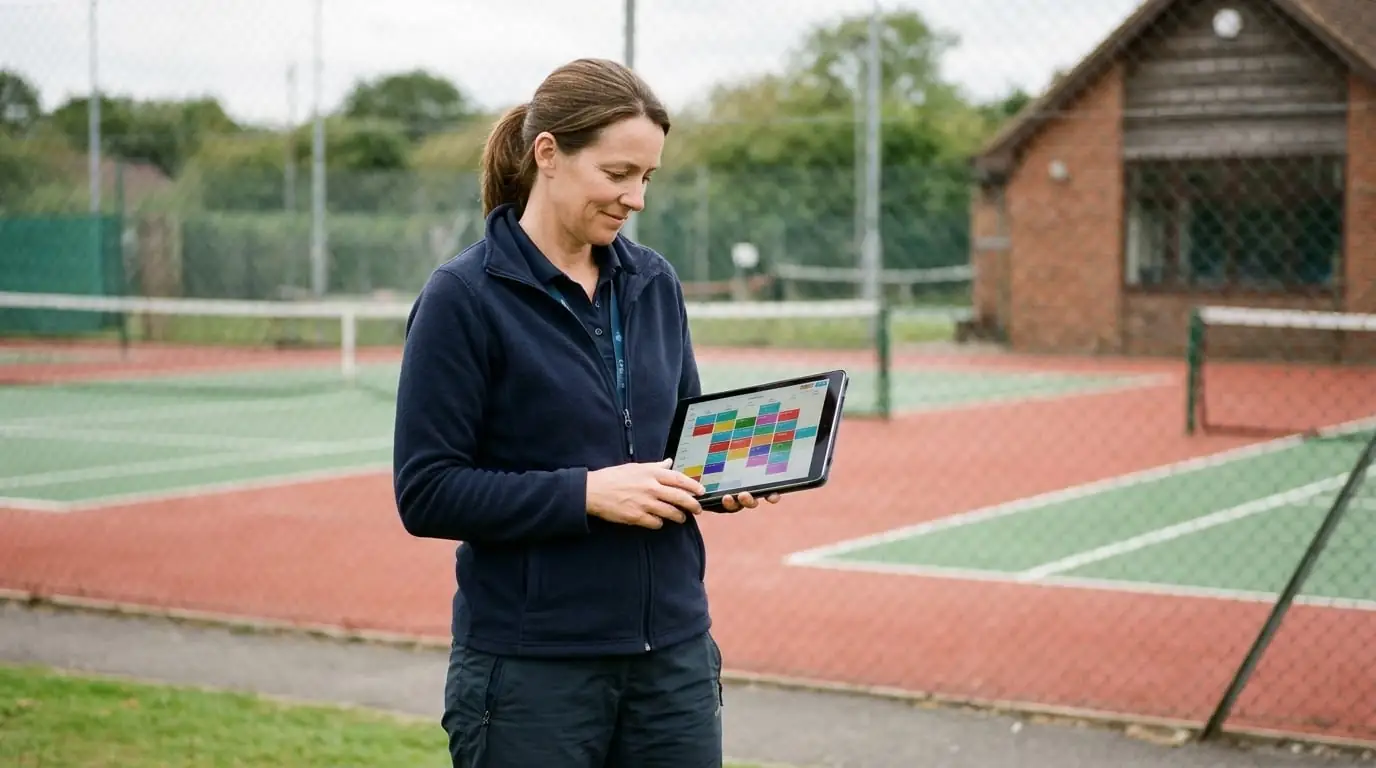
Moving a tennis club to an online booking system takes about six weeks with us, from the first conversation to a live, club-branded app. The safest way to do it is to run the new system alongside your old one until staff and players are comfortable, then phase the old one out. Don't switch everyone overnight.
This article covers what to do in what order, what members have to do on day one, what committees worry about, and when switching isn't the right move yet.
What are clubs usually moving away from?
Most clubs we speak to are on one of two things: older booking software such as ClubSpark, or WhatsApp groups run from someone's phone. Paper sheets and spreadsheets turn up too, but they're less common.
Each one fails in its own way.
| What you use now | What usually goes wrong | What to carry over |
|---|---|---|
| WhatsApp group | Bookings get buried in chat, nobody knows who has a court, and one person ends up as the unpaid referee | Member names, contact details, regular weekly slots |
| Paper sheet or spreadsheet | Double bookings, no way to book from home, nothing to look at when the office is shut | Member list, coach times, recurring bookings |
| Older booking software | Clunky to use, looks like someone else's product, and you may not control your own player data | Player records, existing bookings, coaching schedules |
WhatsApp is the hardest to leave. It's free, everyone has it, and it feels friendly. The honest case for moving is that your club ends up with a proper record of who plays, when, and how to reach them.
How long does it take to switch to an online booking system?
About six weeks for a typical tennis club with us. That isn't dead time. It's when we tailor the system to how your club actually runs and set up the customisations you want.
It also covers something many committees don't expect. We build you your own app, branded as your club, and submit it to the Apple App Store and Google Play Store. Apple reviews every app before it goes live, and you can read their App Store Review Guidelines to see why that takes a little while. Your members download an app with your club's name on it, not ours.
The order looks like this:
- Get in touch. Fill in the contact form or request a demo. We reply within 24 hours.
- Tell us how your club runs. Court types, booking rules, member and visitor categories, coaching, anything that makes your club different.
- We tailor the system. This is the bespoke part. It's built around your club rather than the other way round.
- We import your player details. Your members are in the system before anyone logs in.
- We submit your branded app to the app stores.
- You go live alongside your old system. Then you phase the old one out.
If you want the technical side explained, our manager's guide to how SaaS deployment works for racket sports clubs goes into it.
Should we switch everyone overnight?
No. This is the mistake we'd most like clubs to avoid.
Run the new system in parallel with the old one. Yes, it creates some extra work for a short while. But it gives your staff time to learn the new system without pressure, and your players have the old way as a backup if something confuses them.
Once everyone's comfortable, start phasing the old one out. That might mean closing the WhatsApp group to new bookings first, or taking the paper sheet off the clubhouse wall. How long you run both depends on your club. A tight-knit club with a few regulars may be ready quickly, while one with many casual members will want longer.
What do members have to do on day one?
Very little. That's the point of importing their details first.
We bring your existing player details into the new system before launch, so your club is ready on day one without someone typing in 300 names. Members download your club's app, log in, and book. They aren't starting from scratch.
Before launch, tell members what's happening and when. A short message from the club, a notice by the courts and a line in your newsletter will do. Say which date the app goes live, where to get it, and that the old way still works for now.
Moving member data is a data protection matter in the UK, so it's worth knowing your obligations. The Information Commissioner's Office has plain guidance for small organisations, including clubs. One of the benefits of a white label system is that your club owns its player data, which makes it simpler to look after properly.

What do committees and managers worry about?
Mostly that it'll be more work. That worry is reasonable, and we won't pretend otherwise.
People who've done a job the same way for years don't like change. And at the start, it is extra effort, because your team has to learn a new system quickly. We don't dodge that.
What we see next is that managers and committees start to notice how much time it saves them, and how much easier it is for staff and players. Fewer messages asking "is court 3 free?" and fewer clashes to untangle. Sarah Mitchell, Club Manager at Greenfield TC, uses our system to manage 20 courts without booking conflicts. That's a lot of courts to run off a group chat.
For the committee, these are the questions worth asking any provider, us included:
- Who owns the player data if we leave?
- Can the app carry our club's name and look?
- Can it handle our rules, such as member-only slots, coaching and recurring bookings?
- What does it cost, and how is it charged?
Our pages on recurring bookings and waitlist management show how we handle the rules that committees tend to care about most.
How does the fee work?
There's no single answer, because clubs choose different models. Under our pricing, some clubs pay a very low monthly cost and a small fee on bookings made in the app, with some of that fee paid by players. Other clubs would rather have no player fees or booking fees at all. That's available too, with a higher monthly cost and zero fees on bookings.
For a committee, it comes down to who you want to carry the cost. Is it your players, in small amounts per booking, or the club, as a flat monthly figure? Neither is wrong. [check: Can you give a rough example of each model, such as a typical monthly cost and booking fee for a club with around 10 courts, that we can show committees?]
What results should we expect?
We'd rather give you real examples than a promise.
The first club we onboarded went from around 50 bookings a week to 150 within two months of going live. That's a 300% increase, though it started from a low base, so we'd read it as proof that members book more when it's easy, not as a number every club will match.
James O'Connor at City Padel Club reported a 22% revenue increase within two months. Maria Fernandez, Operations Director at RacquetHub, has praised being able to track revenue by sport and by coach.
Your results will depend on where you're starting from. A club that's already full on a WhatsApp group will see something different from one where courts sit empty because people can't be bothered to ask.
When is switching the wrong choice?
When nobody at your club can run it.
Our system takes a lot of the work out of handling bookings and managing coaches. But it isn't fully autonomous. Someone still needs to look after day-to-day tasks within it, such as setting up rules, checking coach schedules and keeping the club's details up to date. It will save your club a considerable amount of effort, but it won't run itself.
So before you commit, ask: who's our person? A club manager, a committee member, an office administrator. If you have nobody, sort that out first. Otherwise any system will disappoint you.
Some clubs are also content with a shared marketplace app. The difference is that people booking through a marketplace aren't members of your club. They come, play and leave, and you can't market to them. If growing your own membership matters, our comparison of Playtomic and Six Love explains why we think a club-owned app is the better route.
A simple checklist for a smooth switch
| Step | What good looks like |
|---|---|
| Name one person to run the system | A manager or committee member who has time to learn it and is the go-to for staff |
| Set your booking rules before launch | Clear rules on how far ahead members can book, cancellation, and visitor access |
| Import your members | Every current member's details are in the system before the app goes live |
| Tell members early | A message, a notice at the courts and a newsletter line with the go-live date |
| Run both systems together | Old and new run side by side while staff and players learn |
| Phase out the old system | Closed down once everyone is comfortable, not on a fixed date set in advance |
Frequently asked questions
How long does it take to set up an online booking system for a tennis club?
With us, about six weeks for a typical tennis club. That covers tailoring the system to your club, importing your player details and submitting your branded app to the Apple App Store and Google Play Store.
Do we need to stop using WhatsApp straight away?
No. Run the new booking system alongside it, then phase WhatsApp out once staff and players are comfortable. Keeping the old way as a backup is the safest approach.
Will members need to re-enter their details?
No. We import your existing player details into the new system so it's ready on day one. Members download your club's app and log in.
Who owns our members' data?
Your club does. Because the app is white label and branded as your club, you keep your player data and can market to the people who play at your courts.
Is online booking right for a very small club?
It can be, as long as someone is available to run the system. It cuts the work of handling bookings and coaches, but it still needs a person to manage day-to-day tasks inside it.
Ready to talk about your club?
If you're deciding how to move off WhatsApp, paper or an older booking tool, get in touch and tell us how your club runs. We'll reply within 24 hours. You can also see how it looks for your sport on our tennis booking system page.